- Biển số
- OF-821891
- Ngày cấp bằng
- 2/11/22
- Số km
- 22,415
- Động cơ
- 793,849 Mã lực
- Tuổi
- 34
- Nơi ở
- Vinh, Nghệ An
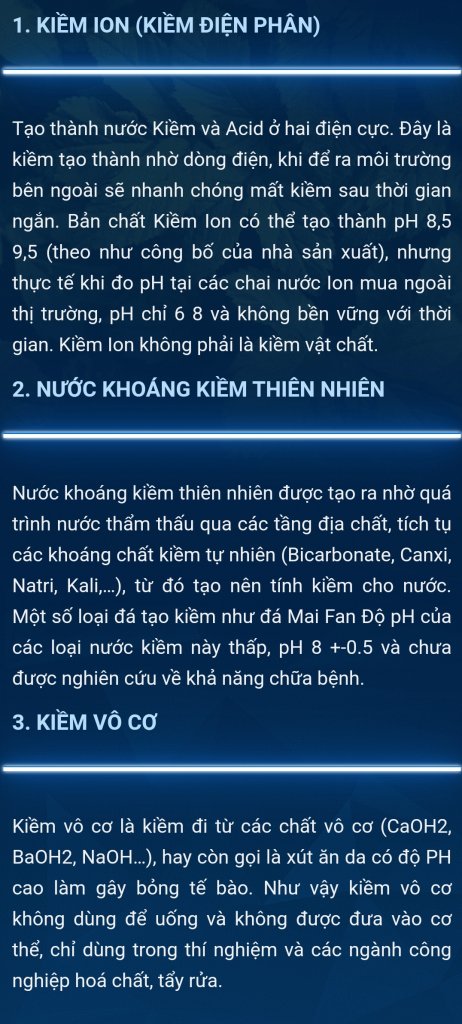
Ko nên dùng nc kiềm PH quá 9,8 vì có thể gây tổn thương mô, tăng kali máu quá mức, Theo đó, các quy định về nước kiềm- điện phân bắt buộc độ pH của nước không được vượt quá 9,8. Khuyến cáo những người bị suy giảm chức năng thận không nên sử dụng nước kiềm mà không có sự giám sát y tế. Các mối lo ngại tiềm ẩn khác về an toàn bao gồm suy giảm tăng trưởng, giảm hấp thụ khoáng chất, vitamin và chất dinh dưỡng, vi khuẩn có hại phát triển quá mức và tổn thương niêm mạc gây khát nước quá mức
"Electrolyzed-Reduced Water: Review II: Safety Concerns and Effectiveness as a Source of Hydrogen Water
Tyler W LeBaron et al. Int J Mol Sci. 2022.
Show details
Full text links
Cite
Abstract
Many studies demonstrate the safety of alkaline-electrolyzed-reduced water (ERW); however, several animal studies have reported significant tissue damage and hyperkalemia after drinking ERW. The mechanism responsible for these results remains unknown but may be due to electrode degradation associated with the production of higher pH, in which platinum nanoparticles and other metals that have harmful effects may leach into the water. Clinical studies have reported that, when ERW exceeds pH 9.8, some people develop dangerous hyperkalemia. Accordingly, regulations on ERW mandate that the pH of ERW should not exceed 9.8. It is recommended that those with impaired kidney function refrain from using ERW without medical supervision. Other potential safety concerns include impaired growth, reduced mineral, vitamin, and nutrient absorption, harmful bacterial overgrowth, and damage to the mucosal lining causing excessive thirst. Since the concentration of H2 in ERW may be well below therapeutic levels, users are encouraged to frequently measure the H2 concentration with accurate methods, avoiding ORP or ORP-based H2 meters. Importantly, although, there have been many people that have used high-pH ERW without any issues, additional safety research on ERW is warranted, and ERW users should follow recommendations to not ingest ERW above 9.8 pH."

 pubmed.ncbi.nlm.nih.gov
"Electrolyzed-Reduced Water: Review II: Safety Concerns and Effectiveness as a Source of Hydrogen Water
Tyler W LeBaron et al. Int J Mol Sci. 2022.
Show details
Full text links
Cite
Abstract
Many studies demonstrate the safety of alkaline-electrolyzed-reduced water (ERW); however, several animal studies have reported significant tissue damage and hyperkalemia after drinking ERW. The mechanism responsible for these results remains unknown but may be due to electrode degradation associated with the production of higher pH, in which platinum nanoparticles and other metals that have harmful effects may leach into the water. Clinical studies have reported that, when ERW exceeds pH 9.8, some people develop dangerous hyperkalemia. Accordingly, regulations on ERW mandate that the pH of ERW should not exceed 9.8. It is recommended that those with impaired kidney function refrain from using ERW without medical supervision. Other potential safety concerns include impaired growth, reduced mineral, vitamin, and nutrient absorption, harmful bacterial overgrowth, and damage to the mucosal lining causing excessive thirst. Since the concentration of H2 in ERW may be well below therapeutic levels, users are encouraged to frequently measure the H2 concentration with accurate methods, avoiding ORP or ORP-based H2 meters. Importantly, although, there have been many people that have used high-pH ERW without any issues, additional safety research on ERW is warranted, and ERW users should follow recommendations to not ingest ERW above 9.8 pH."
Electrolyzed-Reduced Water: Review II: Safety Concerns and Effectiveness as a Source of Hydrogen Water - PubMed
Many studies demonstrate the safety of alkaline-electrolyzed-reduced water (ERW); however, several animal studies have reported significant tissue damage and hyperkalemia after drinking ERW. The mechanism responsible for these results remains unknown but may be due to electrode degradation...
pubmed.ncbi.nlm.nih.gov